Next meeting 11/13 – Potluck and Show-'n'-tell
Our annual potluck and show-n'-tell will be held at 6:00 p.m. at St. James Lutheran Church, 4771 Broadview Road. Bring a dish to share and an artifact from your past.
Our membership year begins in September so please consider paying your 2026-7 dues this month. Pay at a meeting or
online here.
Charles A. Mooney school
HSOB has received a donation of the Charles A. Mooney Intermediate School artifacts, which closed at the end of the 2025–6 school year. Chas. A. Mooney school opened on Montclair Ave. in 1964 with 7th and 8th grade students and teachers from Benjamin Franklin and Wm. Rainey Harper. In 2005 Mooney transitioned from a junior high to a K-8 school, eventually including a preschool. The school further evolved in 2012 as the Facing History New Tech High School was added to the campus. Charles A. Mooney served on the Cleveland Board of Education from 1945-1961, serving as president from 1951-3 and 1958-9.
Our new home for Old Brooklyn's history 9/13
We're pleased to share that the Historical Society of Old Brooklyn has moved in to our new home at 2221 Broadview Road. Interior work was completed and our collection has now been moved from storage.
While we are not yet open with regular hours, this marks an important step forward. After a period of uncertainty, we're glad to have a place where our collections can once again be cared for, shared, and experienced by the community. Check it out — we think you'll be pleased with our new home. Call for appointment.
It will be a while before the dust settles and all the boxes are all opened! Meanwhile there are still ongoing costs—utilities, insurance, and the everyday supplies that make our work possible. Memberships and donations continue to play an important role in helping us get established.
We're encouraged by this next chapter and look forward to welcoming you in the months ahead. In the meantime, please continue to enjoy our digital gallery and online collection database. We regret any inconvenience and appreciate your understanding during this transition.
As you may know, HSOB had to relocate due to our eviction from the Greenline Building. For more information about the redevelopment of the Greenline Building site see Pearl & Memphis below.
Caring for What Matters
 Here's to renewal and rebuilding! The Historical Society is still completing a major transition to our new home. Thank you to everyone who has supported us during this time. If you'd like to help us get up and running in our new space, your membership or donation continues to make a difference.
The old neighborhood
Even if you're no longer an Old Brooklyn resident, many of you hold this neighborhood close. Whether it was childhood or early adulthood, Old Brooklyn helped shape who you are. The Historical Society is a homecoming—and you're always welcome. We invite you to keep those memories alive and pay forward to those who are creating their own stories here.
A sense of place
Loving a place means understanding its story. Our history is more than a record of the past, it helps shape our future. When people feel connected to where they live (or once lived), it strengthens identity, belonging, and long-term sustainability. A strong Historical Society helps anchor that sense of place for Old Brooklyn now and for generations to come.
A new home for Old Brooklyn's history is taking shape. Thank you for helping us build it! As we prepare for the Historical Society's next chapter, your membership or donation helps safeguard Old Brooklyn's history so it can continue to inspire future generations.
Pearl & Memphis
Learn about the history and proposed future of our downtown intersection.
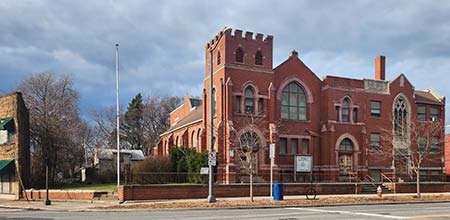
Gothic Revival St. Luke Evangelical and Reformed Church building, built in 1903, with a
school added in 1925. Features include a crenellated corner tower, lancet window openings on sanctuary building and school, and attached buttresses. A "Good Shepherd" stained glass window is found on the original structure's gable section.
Discover Old Brooklyn: A Neighborhood Rich in History
Nestled on the West Side of Cleveland, Old Brooklyn spans about 6 square miles and is just five miles south of downtown. Its borders stretch from Big Creek and the Brooklyn Centre neighborhood to the north, the Cuyahoga River and the village of Brooklyn Hts. to the east, Parma to the south, and Brooklyn to the west.
Old Brooklyn has its roots in the original Brooklyn Township, organized as a governmental structure in 1818. The first settlers, who journeyed here from Connecticut, arrived in 1812, and by 1814, more had settled south of Big Creek Valley. These early pioneers used Indian trails as the foundations for the roads we know today—Pearl, Broadview, and Schaaf.
In 1838, Brighton Village was briefly incorporated around what's now the intersection of Pearl and Broadview Roads. Over the years, as German farmers moved in, the area grew and evolved. By 1889, the village was renamed South Brooklyn. Then, in 1905, the area began to annex into the City of Cleveland, ultimately becoming part of the city by 1927. The move was sparked by South Brooklyn's prized light plant, which was established in 1902.
Old Brooklyn's growth also owes much to its agricultural roots—specifically greenhouse gardening. Beginning in 1887 along Schaaf Road, the area earned the nickname "Greenhouse Capital of the United States" by the mid-20th century. And we can't forget one of the neighborhood's most beloved landmarks: the Cleveland Metroparks Zoo, which opened in 1914 and continues to be a major draw for visitors and locals alike.
Meetings and more
Watch Events and Facebook for the latest news on HSOB events and whereabouts and be sure to mark your calendars!

There's a cemetery on Broadview? (Not Brooklyn Hts. Cemetery)
YES! Brooklyn Union Burial Ground. Located on Broadview Road near Spring Road. The Historical Society maintains this historic burying ground. ... Learn more.
Always more to come...
We invite you come along as our organization, our museum, and this website grow. If you share our interest in preserving and sharing the past, we encourage you to join us in our endeavors.
Join Us
Membership is only $20 a year.